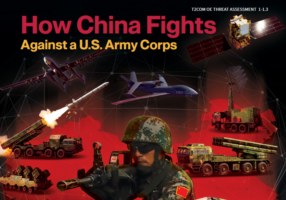

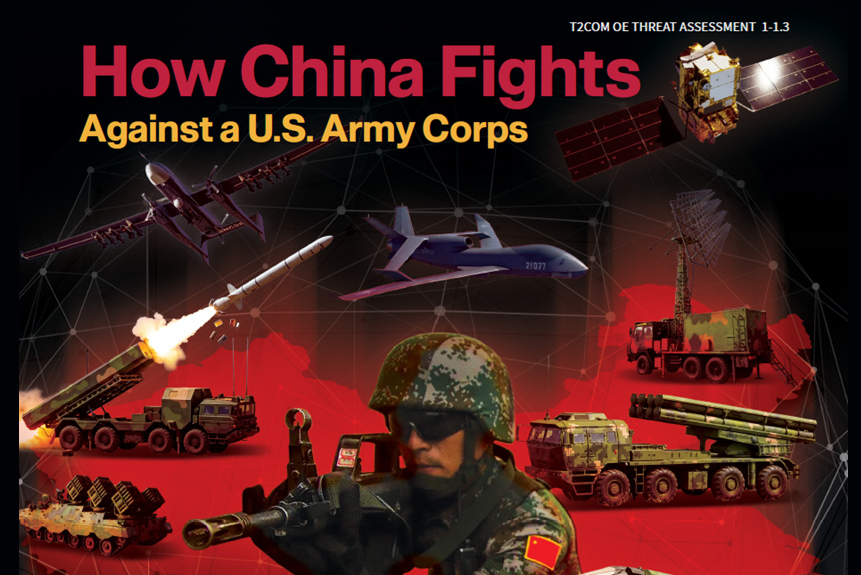
T2COM OE Threat Assessment 1-1.3, How China Fights Against a U.S. Army Corps
Distribution A: Approved for public release
File Size:
9348 KB
File Type:
Page Count:
36
Share & Get The Message Out
This paper provides a threat-informed framework for understanding how the People’s Liberation Army (PLA) might fight as a joint force in large-scale combat operations (LSCO) against a U.S. Army corps operating within a Joint Task Force. Building on previous T2COM G-2 assessments, it examines how a PLA theater command integrates ground, air, naval, cyber, space, and information capabilities to conduct systems warfare designed to degrade, disrupt, and ultimately collapse a U.S. operational system.
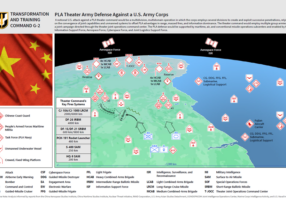
China’s strategic approach centers on achieving information dominance and shaping conditions before conflict begins. The PLA leverages extensive capabilities in the space, cyber, electromagnetic, and cognitive domains to delay U.S. mobilization, degrade command and control, restrict theater access, and blind intelligence and fires networks. Once hostilities begin, theater-level joint operations are synchronized through a theater joint operations command center that integrates assets across the PLA Army, Air Force, Navy, Rocket Force, Information Support Force, Cyberspace Force, and Aerospace Force.
In a notional PLA offensive, the U.S. corps would face a multidomain campaign executed through five stages of conflict: extended shaping, unfolding of forces, assault, breakthrough and annihilation, and deep operations. As part of its push toward “intelligentized” warfare, the PLA has transformed its tactical echelons into pervasive reconnaissance-strike complexes heavily reliant on unmanned aerial systems. These integrated assets aim to accelerate the kill chain and degrade the corps’ command, control, communications, computers, cyber, intelligence, surveillance, reconnaissance, and targeting architecture, thereby fragmenting U.S. formations and preventing reconstitution. The corps would operate under persistent reconnaissance, degraded communications, and continuous long-range fires.
In a notional PLA defense, the PLA would adopt an integrated positional—rather than static—defense designed to withstand penetration, impose attrition, conduct preemptive strikes, and preserve the coherence of the theater defense system. The PLA’s layered fires, advanced ISR networks, air and maritime integration, and extensive unmanned systems would enable rapid detection and targeting of U.S. high-value nodes. PLA counterattacks would combine precision strikes, electronic warfare, and maneuver by heavy, medium, and light combined-arms brigades to restore the defensive line and regain initiative.
Across both the offensive and defensive scenarios, PLA systems warfare poses significant challenges to U.S. intelligence, fires, and protection warfighting functions. The PLA’s ability to link strategic enablers with tactical formations compresses decision cycles, strains sustainment, and complicates joint synchronization. To prevail in LSCO, U.S. corps would benefit from realistic training focused on maintaining decision advantage, operating with degraded networks, protecting critical nodes, conducting counterreconnaissance across all domains, and synchronizing joint fires and effects under continuous pressure.
Related Products