
Operational Environment 2024-2034 Large-Scale Combat Operations Conditions and Implications Handout
by T2COM G-2
Distribution A: Approved for public release
File Size:
1007 KB
File Type:
Page Count:
1
Share & Get The Message Out
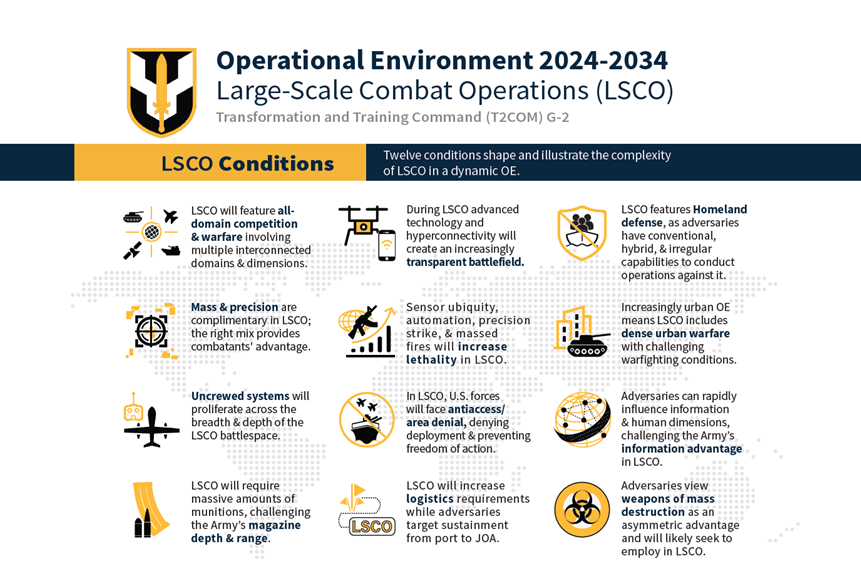
Twelve conditions shape and illustrate the complexity of large-scale combat operations (LSCO) in a dynamic OE.
- LSCO will feature all-domain competition and warfare involving multiple interconnected domains and dimensions.
- Mass and precision are complimentary in LSCO; the right mix provides combatants’ advantage.
- Uncrewed systems will proliferate across the breadth and depth of the LSCO battlespace.
- LSCO will require massive amounts of munitions, challenging the Army’s magazine depth and range.
- During LSCO advanced technology and hyperconnectivity will create an increasingly transparent battlefield.
- Sensor ubiquity, automation, precision strike, and massed fires will increase lethality in LSCO.
- In LSCO, U.S. forces will face antiaccess/area denial, denying deployment and preventing freedom of action.
- LSCO will increase logistics requirements while adversaries target sustainment from port to JOA.
- LSCO features Homeland defense, as adversaries have conventional, hybrid, and irregular capabilities to conduct operations against it.
- Increasingly urban OE means LSCO includes dense urban warfare with challenging warfighting conditions.
- Adversaries can rapidly influence information and human dimensions, challenging the Army’s information advantage in LSCO.
- Adversaries view weapons of mass destruction as an asymmetric advantage and will likely seek to employ in LSCO.
Five implications drive U.S. Army training, education, and Leader development to prepare for LSCO.
- LSCO requires combatants to understand the dichotomy between the art and science of war.
- Human and materiel costs of LSCO suggest combatants benefit from understanding annihilation vs. attrition.
- Transparency, lethality, and challenges to movement in LSCO may require a reassessment to maneuver, fires, and protection.
- Rapid adaptation in LSCO is fundamental, combatants who prioritize this will be better able to exploit fleeting opportunities.
- People are the advantage in LSCO, a primacy long held by the U.S. Army over our adversaries.
Related Products