
How China Fights Against a U.S. Army Division
by T2COM G-2
Distribution A: Approved for public release
File Size:
7628 KB
File Type:
Page Count:
32
Share & Get The Message Out
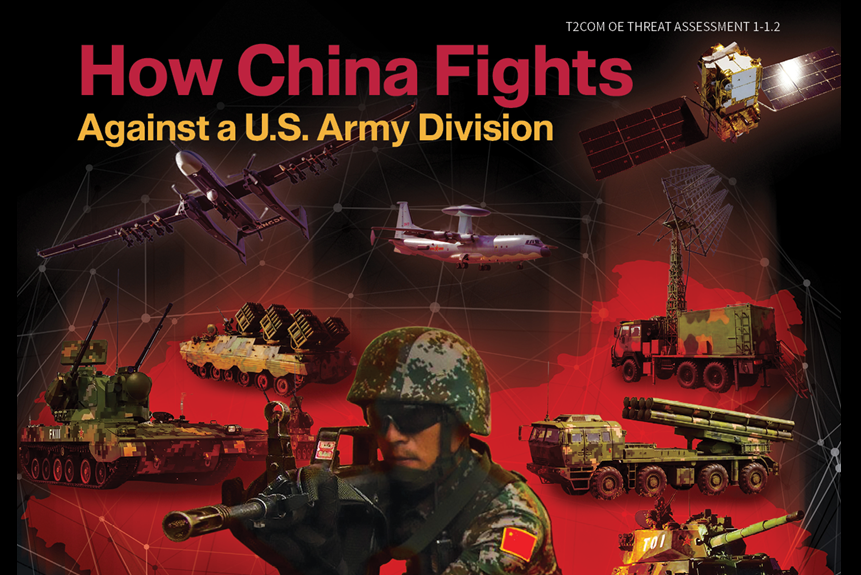
In a potential conflict involving large-scale combat operations (LSCO) between the United States and China, a U.S. Army division would face a People’s Liberation Army (PLA) group army capable of executing a layered, multidomain campaign designed to isolate, paralyze, and ultimately dismantle the division’s operational system. The group army would be reinforced by joint and support capabilities from the PLA theater command, including the Air Force; Navy; Rocket Force; and specialized information, cyberspace, space, and logistics support forces.
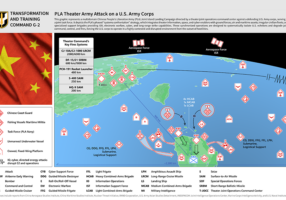
A U.S. Army division defending against an attacking PLA group army would contend with a multiweek campaign designed to achieve information dominance, isolate the division, and set the conditions for its defeat before corps-level reinforcements could intervene. In six phases, the PLA would progress from strategic and operational shaping—including space; cyber; electronic warfare (EW); and intelligence, surveillance, and reconnaissance (ISR) operations targeting the division’s command and control (C2), fires, and sustainment—to preliminary maneuver and multidimensional penetrations supported by long-range fires, one-way attack (OWA) drones, special operations forces (SOF), and dense air defenses. The division’s counterattacks would be met with ISR-cued rocket and artillery strikes, rocket-delivered scatterable mines, OWA drone swarms, and coordinated SOF raids, followed by encirclement operations meant to fragment U.S. Army brigade combat teams (BCTs) into isolated pockets and enable systematic destruction in detail.
A U.S. Army division attacking a PLA group army would confront an active, elastic, and layered defensive system designed to lure, attrit, and ambush attacking BCTs before destroying penetration forces with massed fires and echeloned counterattacks. After an extended shaping period of intelligence collection and preemptive strikes against the division’s C2, fires, aviation, and logistics, the division’s advance through the group army’s deep area would be contested by ISR‑cued rocket fires, OWA drones, and EW targeting ground and air communications. As the division’s BCTs move into the PLA group army’s frontal blocking and frontier defense zones, they would encounter complex obstacle belts, decoys, mutually supporting strongpoints manned by heavy combined-arms battalions, and dense integrated air defenses—all covered by long‑range artillery, attack aviation, and SOF activity in the division’s rear. If BCTs penetrate into the depth defense zone, the group army would seek to halt and reverse gains with massed fires and multiechelon counterattacks, then transition to a defensive consolidation posture after intercepting or defeating U.S. reinforcements.
Operating against a PLA group army in LSCO would stress the division’s intelligence, fires, and protection warfighting functions due to the PLA’s doctrine of “systems confrontation,” which it executes through information dominance and integrated multidomain fires. The group army’s reliance on a deep, persistent reconnaissance architecture would require the division to conduct continuous, aggressive counterreconnaissance well before D-Day and throughout the operation. The group army’s integrated network of long-range precision fires, cued by ISR and synchronized with EW, would be optimized to find and strike division fires, command, and sustainment nodes, suggesting the need for U.S. formations to train for rapid emplacement, firing, and displacement under degraded conditions. The PLA’s systems-level approach, which links strategic enablers like SOF, EW, cyber, and information operations to tactical formations, underscores the importance of multidomain protection that emphasizes cyber hygiene, emissions discipline, deception, and air and missile defense to counter both kinetic and nonkinetic attacks. Finally, realistic emulation of PLA equipment, signatures, and tactical behaviors at home stations and Combat Training Centers is essential to prepare division commanders and staffs to recognize patterns, make faster decisions, and maintain combat effectiveness in LSCO.
Related Products